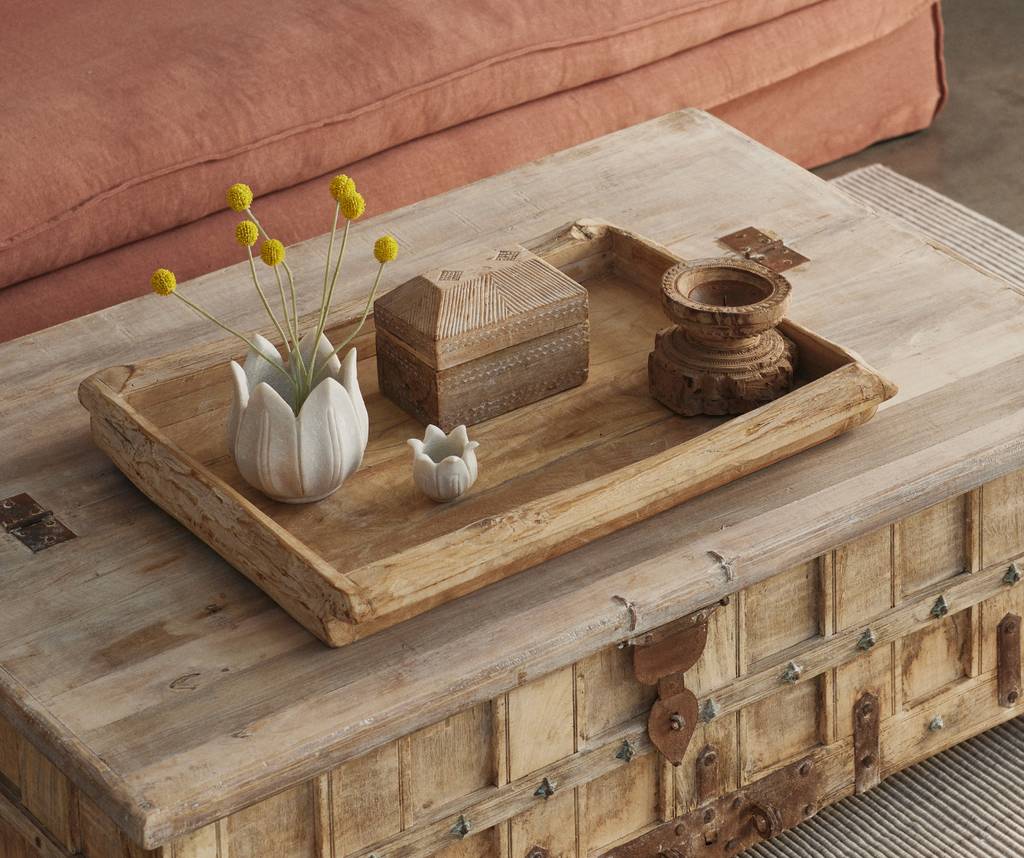
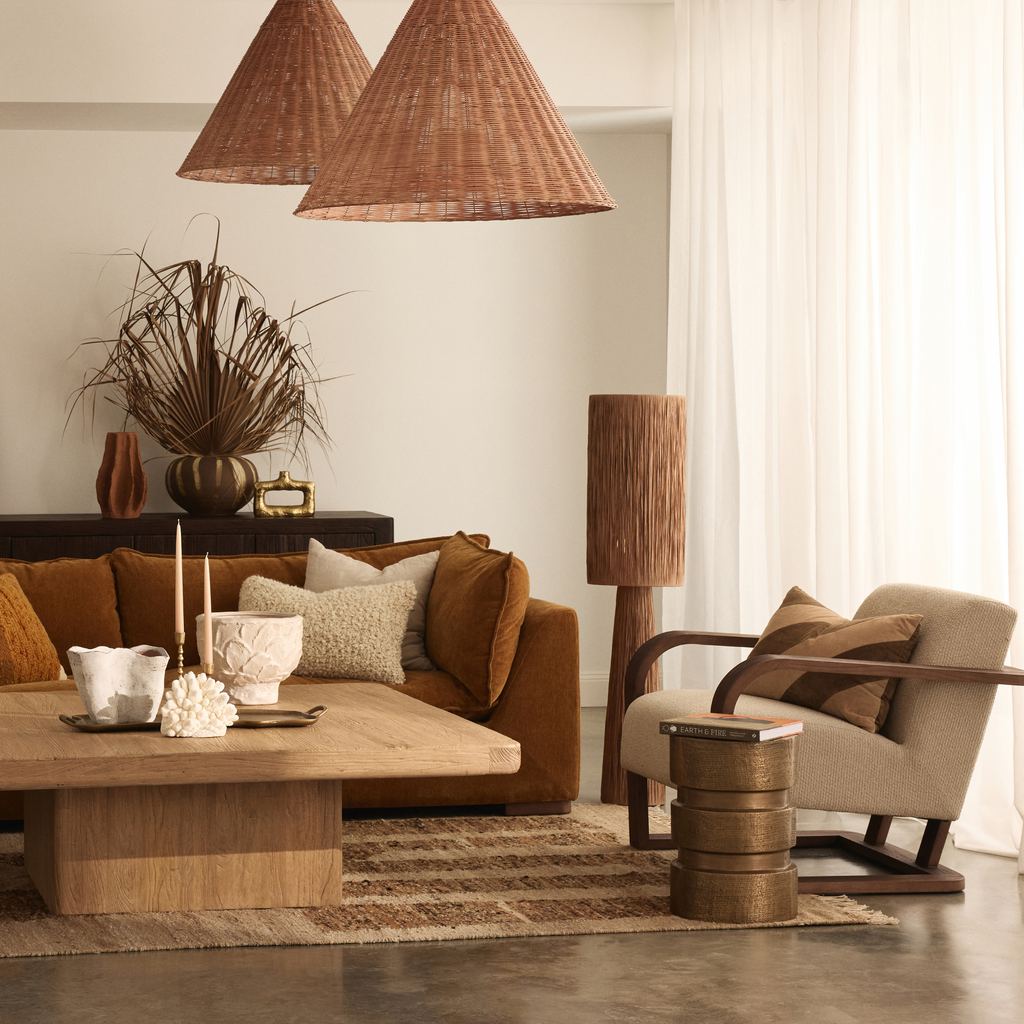
For a time, rooms were pared back—simplified, stripped of excess. Beautiful at times, but often missing the depth that makes a place feel truly lived in. Now, there is a return. A leaning back into character. Into pieces with history. Homes that feel gathered and collected.
India is a place of contrast: colour and dust, vibrancy and stillness.
Pigment against raw concrete. Hand-carved timber against earth and stone.
Each piece in this collection has already lived a life.
Worn timber.
Softened edges.
Faded pigment.
Layered patina.
Marks gathered over time, left as they were found or restored to give new life.
No two are ever exactly alike.
These are the kind of pieces you build a room around.
But before they reached our shores, they were part of a journey that began with a pixelated YouTube video and a bag of muesli bars.
This is the real story of how they were Found in India.

These stories have never been written down.
They live in the gaps between meetings and late night conversations and the moments where someone asks "but how did you actually start importing from India?" and we end up talking for an hour.
So here are some of them. The real version. The one with the muesli bars and the 55-degree dump room and the man who laughed at us. India has been part of who we are since the very beginning, and these stories are part of that.
We hope you enjoy.
Tara x


YouTube Slow Scroll
Before our first trip to India, we had one contact, no shipping agent, no sourcing agent, and genuinely no idea where to start. We knew we wanted to go to Rajasthan. We'd heard Jaipur was the place. Beyond that, we were completely flying blind.
So one night — I think it was pretty late, the kids were in bed — I found myself on YouTube looking up footage of the main street of Jaipur. And I started slowing the video down. Pausing it. Zooming in on storefronts to see if anything looked like a supplier worth visiting.
Danny watched me do this for a while and then said, "What are you actually doing right now?"
I was trying to find suppliers by slowing down a YouTube video. Amateur hour doesn't quite cover it. But when you don't have a playbook, you make one up, and sometimes that means squinting at a pixelated shop front at 11pm trying to work out if that sign says "wholesale" or "wholesale only."
We laugh about it now. But honestly? We'd do it again. It's that exact stubbornness — the refusal to say "I don't know how to do this so I won't" — that's gotten us everywhere we've ever been.


The Medieval Knight & The Muesli Bars
Our entire preparation for our first trip to India came down to one person. One. And she imported replica medieval knight armour and swords.
Danny's dad knew someone who knew her. That was the chain. She'd dealt with Indian suppliers for years — just not the kind of suppliers we were looking for. But she was incredibly generous with her knowledge and she gave us everything: hotel names, what to eat, what not to eat under any circumstances, which areas to stay in, what to watch out for.
And then — brilliantly — she was travelling over at the same time. So we said we'd meet her there.
The first time we ever spoke to her in person was at Singapore Airport on our layover. We'd only ever emailed. We shook hands at Changi, had a quick chat, confirmed the plan, and then boarded the next flight to Delhi together.
A woman who sold knights in armour was our entire India strategy. And honestly, she was brilliant. Some of the best advice we've ever been given came from someone who had nothing to do with homewares.
We've never forgotten that lesson. Help comes from the strangest places. Say yes to the introduction. Make the phone call. You never know.
The 55-Degree "Dump Room"
I'm not exaggerating when I say that walking into that textile showroom felt like the best moment of the entire trip. Floor to ceiling colour. Block-printed cottons, hand-stitched kantha, silks I'd never seen outside of a magazine. This was exactly what we'd come for. We were absolutely beside ourselves.
And then we asked about minimums.
We couldn't touch them. They were dealing with buyers who ordered tens of thousands of units at a time. We were asking about thirty. The gap wasn't even in the same universe.
So they took us to the dump room.
It was a large room. It was approximately 55 degrees inside. It was full of end-of-run textiles — the leftover metres from big orders, the final run of a print that had been discontinued, miscellaneous pieces with nowhere else to go. Other buyers' leftovers.
We spent hours in there. Sweating through our clothes, pulling pieces out, holding them up, laying things next to each other to see what worked. It was chaotic and unglamorous and very, very hot.
We came out with tablecloths, kantha quilts, blankets, cushion covers — a collection where we might have ten of one print, four of another, and only one of the next. Every single piece different. No two exactly alike.
We didn't realise at the time that we'd just accidentally invented our entire point of difference. The randomness was the whole point. The fact that every customer would find something nobody else had — that's still what we're known for. It started in a 55-degree dump room in Jaipur. Not exactly the origin story we imagined, but we'll take it.

The Best and the Worst in Five Metres
We hired a driver to take us from Jaipur to Jodhpur. How long did it take? Danny says six hours. I say more like eight. We've never agreed on this.
What I can tell you is that Indian highways are an experience unlike anything else. One minute you have three lanes of sealed road and everything is moving. The next minute the road narrows to gravel because they're fixing a section, and suddenly you're sharing that strip of dirt with trucks, buses, bikes, tractors, cows, people on foot doing what appeared to be pilgrimages, and — at one point — a truck that had decided the road was better on our side and was simply coming at us head-on because it was bigger than everything else.
At some point our driver decided to overtake a truck. Danny watched our bonnet disappear underneath the back of the truck in front. Literally go under it. He started kicking the back of the driver's seat.
We also passed a truck that had rolled and spilled its container across the road. A tractor had arrived to deal with it. The container was heavier than the tractor. The tractor lifted off the ground. Everyone was very calm about this.
India, Danny always says, is a place you can love and hate within five minutes. You look at something completely extraordinary and then you turn your head and wish you hadn't. It's the best and the worst in the same five metres of road.
We wouldn't fly the next time. We did, obviously. We always fly now. But we wouldn't have missed that drive for anything.

The First 20-Footer
These are not pieces made en masse, or made to be replaced.
Two weeks in India. Two cities. More kilometres by road than either of us want to remember. Hours in showrooms that were either freezing with aircon or sweltering without it. Evenings on Google trying to work out who to see the next day. Full days where we found nobody and went back to the hotel and started again.
We came home with a 20-foot container. For those playing along, a 20-footer is the small one. Approximately the size of a garden shed.
We had to take on our very first warehouse lease just to have somewhere to put it — a little rented shed that we were incredibly proud of. The day it arrived, we unloaded it ourselves. Me, Danny, my mum and dad, Danny's brother, his wife, their kids. Everyone carrying boxes and pieces of iron furniture through the doors.
Every single thing that came out of that container, someone said "oh, this is cool." Every single one.
It was exactly like Christmas. Actually better than Christmas, because we'd earned every piece of it.
We'd also brought home some old wooden columns and a beautiful metal railing that we built directly into the Indigo Love fitout — replacing posts where we'd knocked out walls, wrapping the front of the counter. That counter is still one of our favourite things we've ever made.
All of that work. All of that driving and sweating and googling and being turned away. For one 20-foot container.
We'd do it a hundred times over.
Fifteen years on, we still go to India. We still get surprised. We spend two days now instead of two weeks, but the feeling when we find something extraordinary hasn't changed at all. That piece where you just know. Where you pick it up and think, someone's going to love this.
These are pieces chosen by us, to be kept by you for years to come. They are made slowly, by hand. They bring weight and warmth to a space—a sense of story that cannot be manufactured.
For homes that seek depth over decoration. Character over perfection.
That’s what Bringing the World Home has always meant to us.
— Tara & Danny FEW & FAR · INDIGO LOVE


Drawing from years of experience in homewares and design, we celebrate conscious buying, artisanal craftsmanship, and are driven by the belief that every space should be a collection of pieces that tell stories from past and present and make ways for the narrative to continue in the future. Our mission is to inspire, guide, and help you weave a unique and meaningful story within your own walls.